
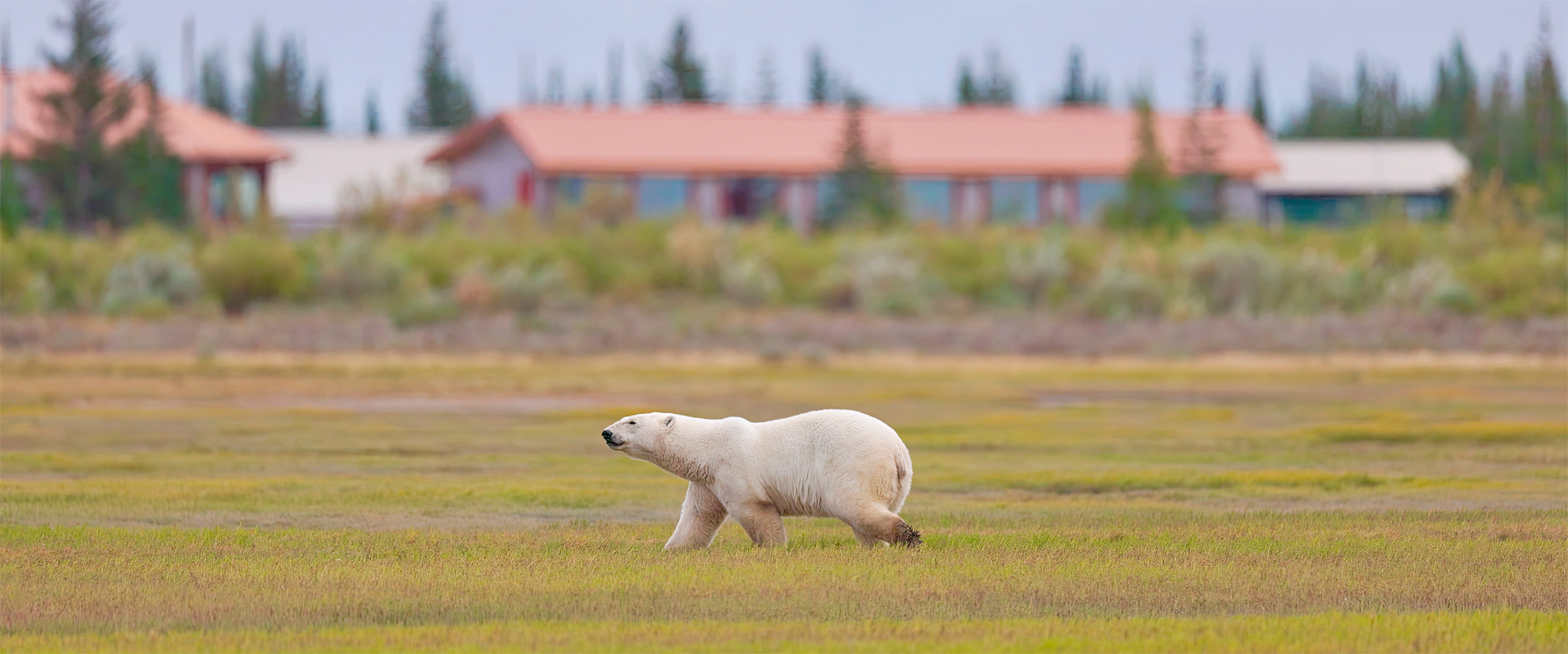
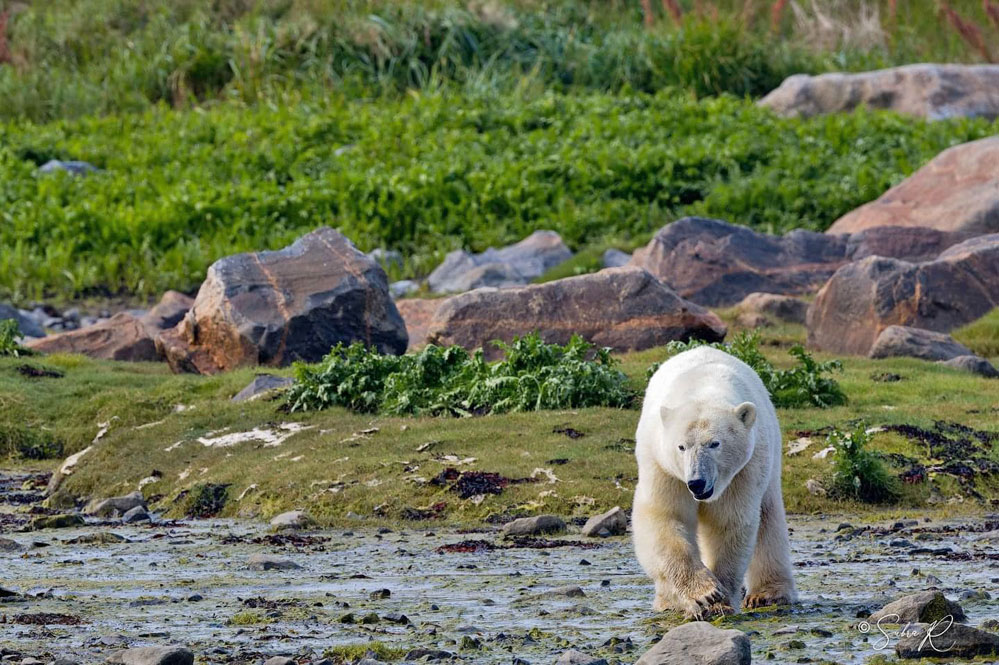
Polar bear walking on the beach at Seal River Heritage Lodge. Christina Schutt photo.
Most people think polar bear season is October and November. That is the freeze-up window when bears congregate near Churchill. The actual season on the Polar Bear Highway is July through November. Five months. The bears are walking the coast the entire time.
From July through November, the great white bears of the Western and Southern Hudson Bay subpopulations travel a coastal corridor that stretches more than a thousand kilometres along the western and southern shores of Hudson Bay. They move from the boreal edge of northern Ontario, past the Manitoba river deltas, past the town of Churchill, and on toward the cooler northern waters that border Nunavut. Guides, biologists, and Cree and Inuit who have watched these movements for generations call this route the Polar Bear Highway.
Churchill Wild’s three remote ecolodges, Nanuk Polar Bear Lodge, Dymond Lake Ecolodge and Seal River Heritage Lodge, sit directly on this corridor. That is not a marketing claim. It is a geographic fact, and it is the reason Churchill Wild can offer ground-level polar bear safaris from July through November, not just during the traditional October-November freeze-up season. No other commercial operation offers polar bear walking safaris in the spring, summer and fall, from permanent luxury ecolodges.
What is the Polar Bear Highway?
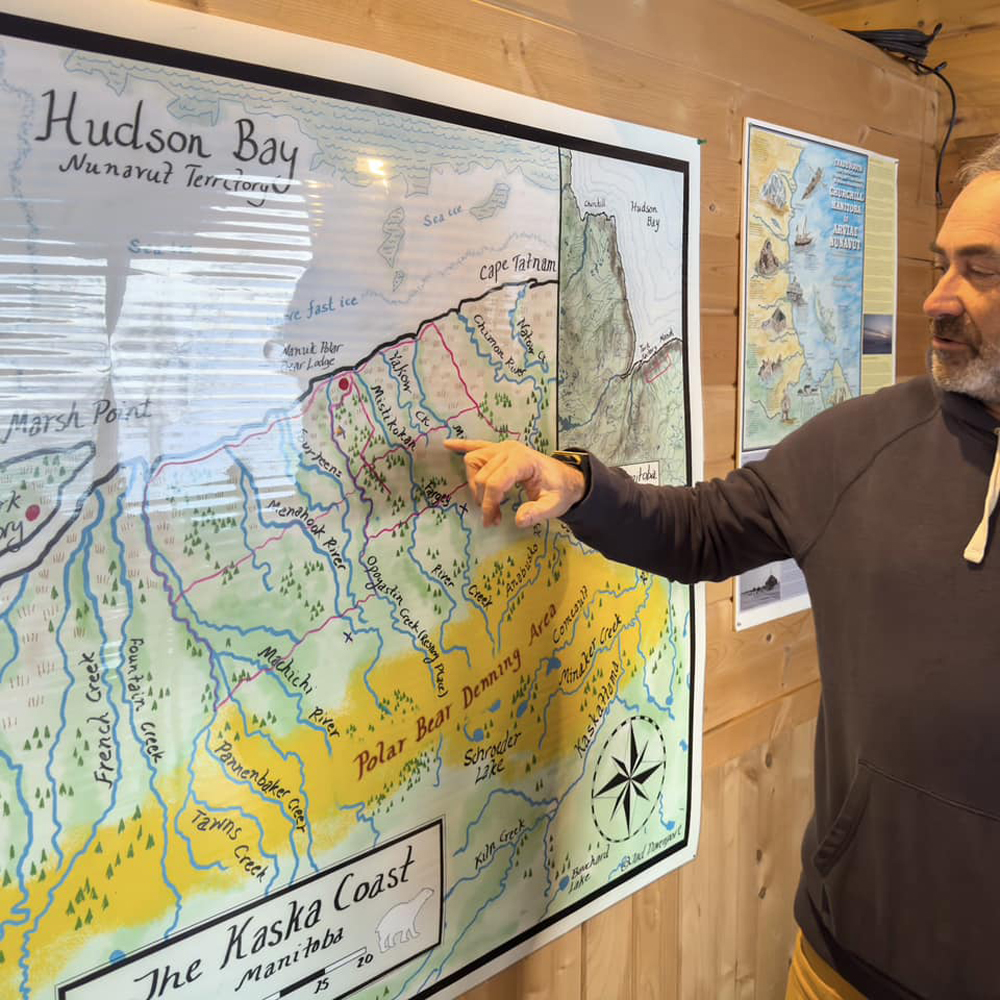
Guide Boomer Jerritt mapping out the routes to the polar bear dens at Nanuk. ArcticWild.net photo.
The Polar Bear Highway is the seasonal coastal route used by polar bears once Hudson Bay loses its ice. It is not a single trail. It is a broad coastal band that runs from James Bay in the south, north along the Ontario coast, across the Manitoba shoreline, and up toward the Nunavut border at Arviat and beyond.
The bears do not migrate in the sense that caribou do. They drift, rest, scavenge, and move in response to wind, temperature, and the slow approach of freeze-up. But the direction of travel for most of the Western Hudson Bay bears is consistent. As summer turns to fall, they walk north and northwest along the coast, gathering near Churchill and the river mouths where freshwater ice forms first.
The corridor passes through three distinct stretches of coast. Each one matters for a different reason, and each one places a Churchill Wild lodge in a position that no other operator can match.
The geography that creates the corridor
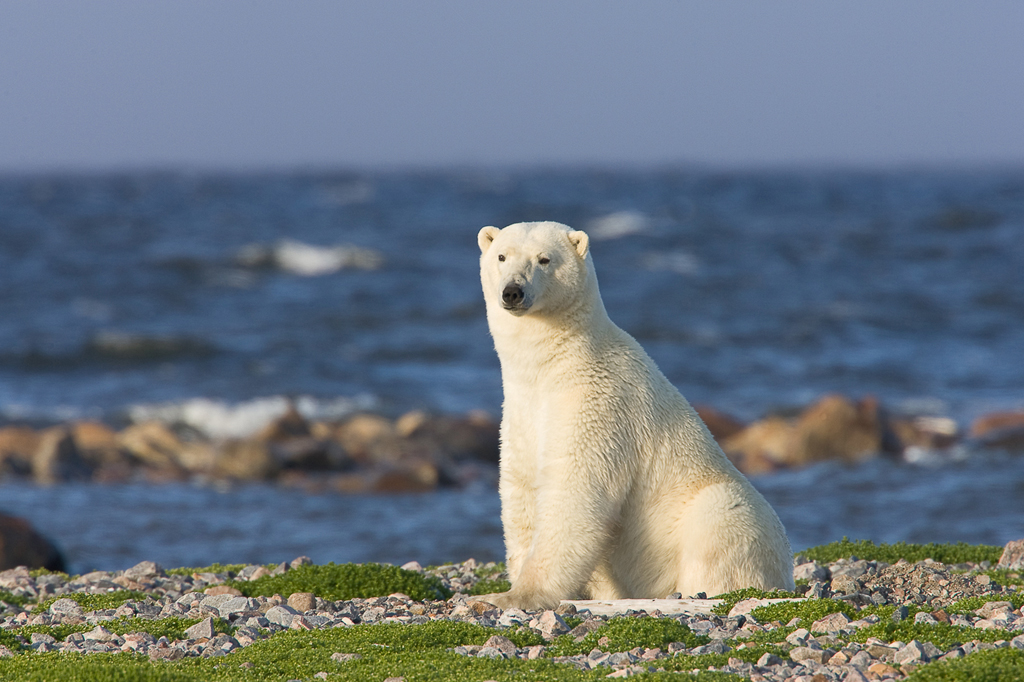
Summer polar bear sitting pretty on the coast of the Hudson Bay. Richard Voliva photo.
Hudson Bay is enormous. It covers roughly 1,370 kilometres from north to south and 1,050 kilometres east to west, an area larger than the state of Texas. Its shape is what creates the highway.
The bay’s western coast is a long, low, gently curving shoreline of tidal flats, coastal fens, willow thickets, sedge meadows, and tundra. There are no cliffs and no real barriers. A polar bear coming off the ice in July can walk for hundreds of kilometres without crossing anything more difficult than a river mouth.
The southern coast, where Nanuk Polar Bear Lodge is located, is where the boreal forest reaches Hudson Bay. This is one of the very few places in the world where polar bears, black bears, wolves, and moose share the same landscape. The Hudson Bay Lowlands here form one of the largest wetlands on Earth, and the long sweeping coastal flats blend with stunted spruce to create a transition zone that no other polar bear habitat replicates.
Moving north from Nanuk, the coast curves past the historic site of York Factory, past the Nelson and Hayes river estuaries, and on toward Cape Churchill. Cape Churchill is a strategic location for the bears because of where the Churchill, Nelson and Hayes rivers drain into Hudson Bay. Freshwater freezes at a warmer temperature than saltwater, so the ice forms there earlier. The unique geography of Churchill, which juts out into the bay, also causes ice floes that form further north to pile up along its shores.
Dymond Lake Ecolodge sits in the tundra just north of Churchill, in country our founding family has known for five decades. Seal River Heritage Lodge sits another sixty kilometres north of Churchill at the Seal River estuary, where the coast turns subtly toward the northwest and the bears continue their walk toward cooler water.
From Seal River, the highway continues north past the Manitoba border into Nunavut, past Arviat and on toward Chesterfield Inlet. The Western Hudson Bay subpopulation extends from the Manitoba and Ontario border in the southeast of its range to Chesterfield Inlet in Nunavut in the northwest.
Why polar bears walk: the climate behind the corridor
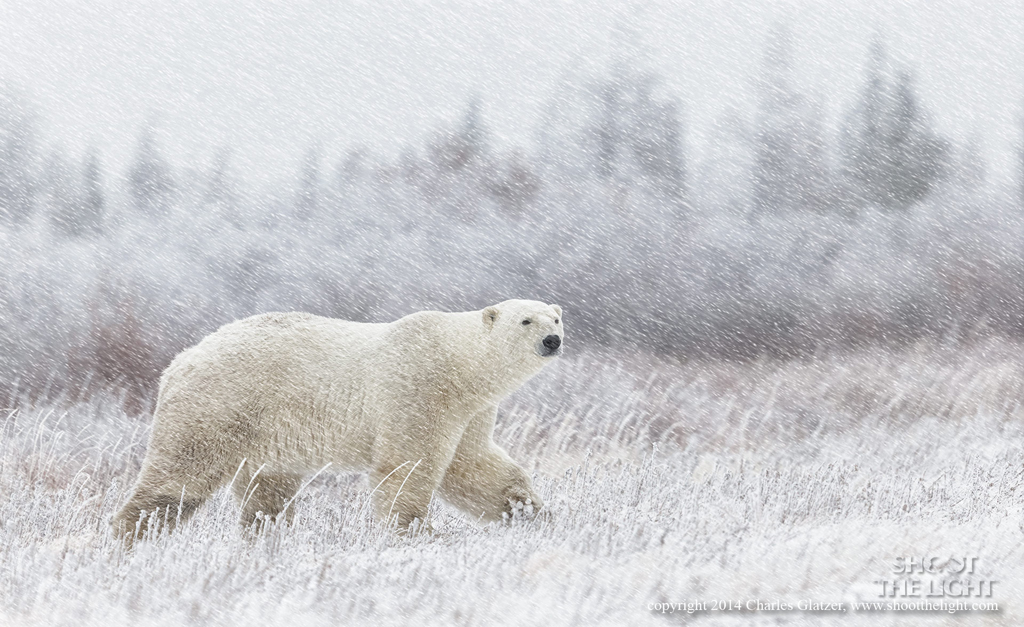
Polar bear walking through a mild snow storm at Nanuk Polar Bear Lodge. Charles Glatzer photo.
The Polar Bear Highway exists because of one fact. Hudson Bay sea ice melts every summer.
Unlike the high Arctic, where sea ice persists year round in many areas, Hudson Bay becomes ice free for several months each year. As sea ice melts, polar bears are forced onto land, and this marks the beginning of their fasting period, since their main prey, seals, become inaccessible until the bay freezes over again in winter.
The timing has shifted. When researchers began studying polar bears in Western Hudson Bay in the 1980s, bears would remain on the ice well into August. In recent years, some bears have started returning to shore in mid-June. In 2025, Western and Southern Hudson Bay saw their fourth and ninth earliest sea ice break-up in 47 years of satellite data.
That extra time on land is the entire reason the walking safari season at Churchill Wild begins in early summer. The bears are there. They have nowhere else to be.
Once ashore, the bears settle into what biologists describe as walking hibernation. They rarely travel far inland and tend to move from one inlet to another, sometimes to avoid territorial bears, sometimes to forage. They rest in dugouts deep enough to reach permafrost, where the ground stays cool, and the mosquitoes are less of a problem. Pregnant females may settle near earthen dens that have been used by generations of bears. Body heat from generations of denning bears has progressively melted the permafrost beneath the floors, so the dens have grown over time.
The bears are not idle. They walk the coast looking for what they can find. A washed up seal carcass. A beluga calf that strayed too close to shore. Eggs from a goose nest. Kelp. Berries. None of it replaces seal fat, but it passes the time and conserves energy until the ice returns.
Polar bears hunting belugas at Seal River: a behaviour the world has been watching
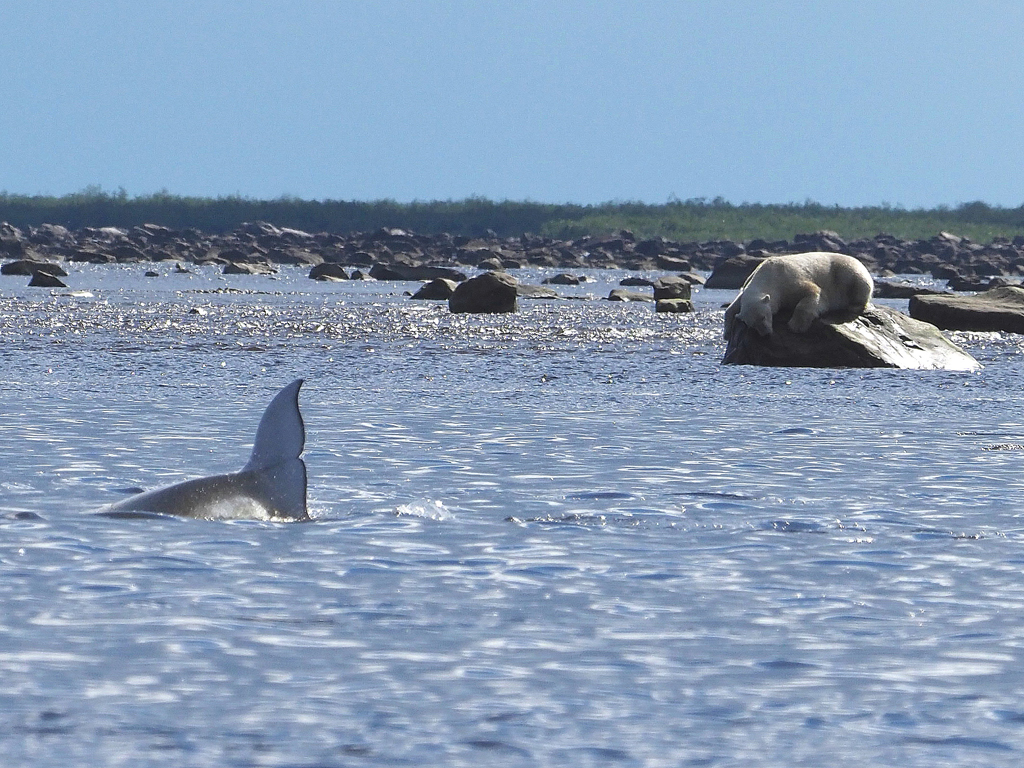
Patient polar bear hunting beluga whales. Seal River Heritage Lodge. Quent Plett photo.
There is one stretch of the Polar Bear Highway where the bears have done something the rest of the world has paid close attention to.
At the mouth of the Seal River, just north of Seal River Heritage Lodge, polar bears have been observed hunting beluga whales. The bears climb onto large boulders near the estuary, wait for hours, and then leap onto the backs of belugas that swim too close during the summer concentration. Churchill Wild guides first documented this behaviour at Seal River in the summer of 2017.
Filmmakers have been coming ever since.
The BBC filmed the behaviour at Seal River for Seven Worlds, One Planet, the David Attenborough series that aired in 2019. The producer of that episode, Chadden Hunter, said in a Canadian Press interview that “when we were filming this behaviour, a lot of scientists couldn’t believe that it was happening. There was absolutely no records in scientific papers, there was no studies on it, and a lot of scientists are champing at the bit to get into this Seal River area to study this group of polar bears.”
National Geographic’s Hostile Planet series, narrated by Bear Grylls, filmed a similar sequence on the same coast for its 2019 finale. In 2022, Sky Nature’s landmark series Predators, narrated by Tom Hardy, devoted much of its polar bear episode to footage shot at Seal River across six different shoots over ten months and four seasons, producing 89 terabytes of video.
The behaviour itself is not unprecedented. Scientific literature documents polar bears hunting belugas in Canada’s far north as far back as the 1980s. What is new at Seal River is the consistency and the visibility. A group of bears appears to have developed and refined a specific technique, in a specific place, at a specific time of year, and they have done it long enough that international wildlife crews can plan shoots around it.
Guests staying at Seal River Heritage Lodge during the summer beluga concentration regularly witness the proximity that makes this behaviour possible. As Pam Massey wrote in a Google review of Seal River Heritage Lodge, “What an extraordinary location! Seal River Heritage Lodge is located right on the Hudson Bay with incredible views of the Bay. Not to mention the amount of wildlife, polar bears, beluga whales, sik-siks, caribou, and THE BIRDS!”
How polar bears may be evolving with the ice changes
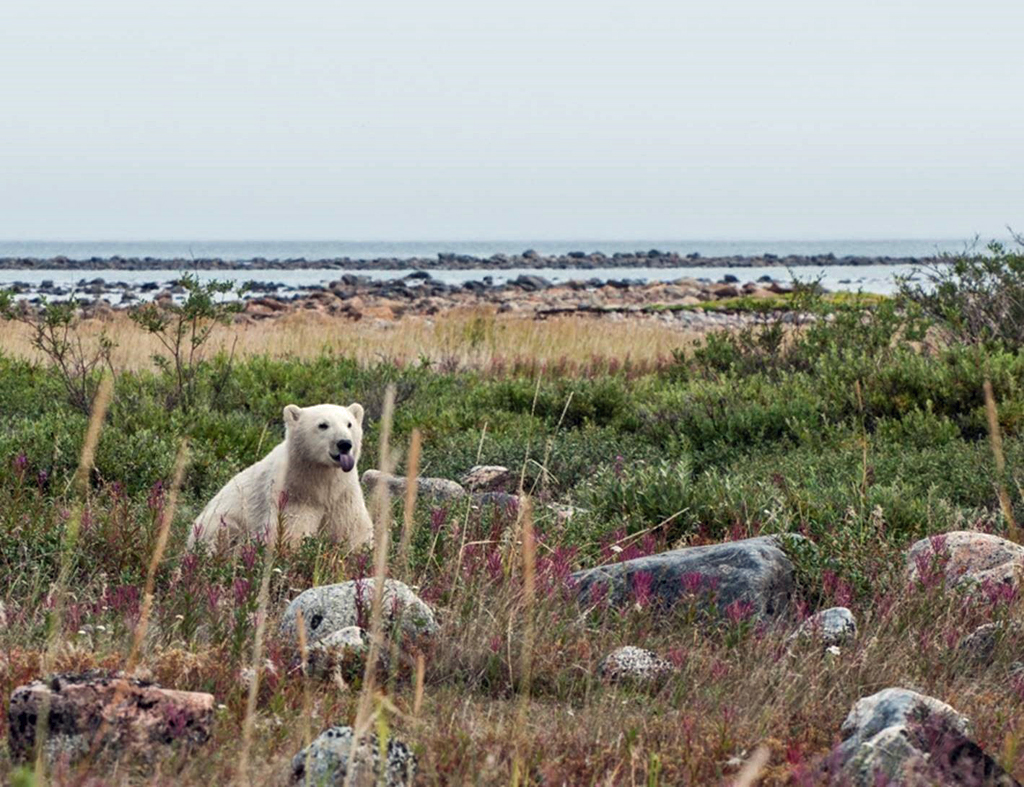
Polar bear cub in late-season fireweed at Seal River Heritage Lodge. Photo by Paul Scriver
The honest answer is that no one knows yet whether what is happening at Seal River represents true behavioural adaptation or simply a behaviour that has always existed and is now being documented because longer ice-free seasons concentrate more bears on land for longer periods.
Polar bears that spend more time on land have more time to encounter belugas, which gather at the Seal River estuary by the thousands every summer. They have more time to learn from each other. They have more time for individual bears to refine techniques like the boulder ambush, and more time for younger bears to watch and copy.
If the Western Hudson Bay subpopulation continues to spend longer periods on land each year, behaviours like beluga hunting from shore may become more common, more refined, and more widely transmitted. That is not the same as saying the bears can replace seal fat with beluga meat. They cannot.
The energy gained from an occasional successful beluga hunt is nowhere near enough to replace the months of seal hunting the bears would do on the ice. Some media coverage has framed this as “starving bears finding new prey.” The bears at Seal River that are engaging in this behaviour are generally not starving. They are using the time they now have.
What it does suggest is that polar bears are not passive in the face of change. They are working with the landscape they have. The bears walking the Hudson Bay coast today may be doing things their grandparents may not have done, in places their grandparents may not have stayed, for longer than their grandparents would have.
Whether this represents evolution in any biological sense, or simply behavioural flexibility within the existing range of the species, is a question for researchers. What it represents for guests at Seal River Heritage Lodge is the chance to witness something that almost no one else in the world gets to see.
Polar bear behaviour along the highway
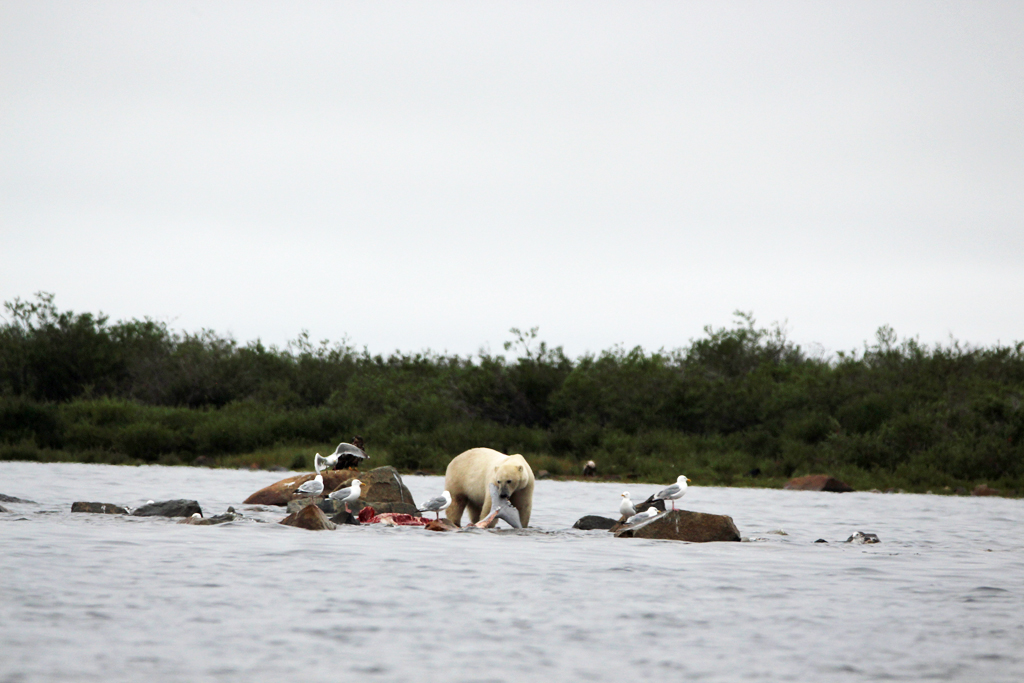
Polar bear with whale tail at Seal River. Photo by Churchill Wild guest Jack Moss.
The behaviour you see along the Polar Bear Highway shifts with the season, and this is one of the reasons Churchill Wild can offer such different experiences across the same five months.
In July and August, bears are settling into summer mode. They are often relaxed. Mothers with cubs of the year travel together. Sub-adults play wrestle on the beaches. Males rest on cool stones along the tidal flats. Belugas swim within sight of the same coast, sometimes within metres of the resting bears. At Seal River, this is the window when the beluga hunting behaviour is most likely to be observed.
By September, the bears start to move. The days shorten. The nights cool. Coastal grasses turn red and gold. The bears begin walking with more intent, drifting north along the coast and gathering near the cooler waters where freeze-up will come first.
October and November are the build-up. Bears congregate near Cape Churchill, around the river mouths, and along the stretches of coast where Churchill Wild’s lodges sit. From early October onward, bears gather on the tundra along the shores of Hudson Bay, waiting for ice to form. At Dymond Lake, Nanuk, and Seal River, snow arrives, and the tundra turns white. The bears, already at their most active before freeze-up, are sometimes seen sparring, sometimes resting in willows, and other times simply walking past the lodge fences.
This is the corridor. The bears are not visiting it. They live in it.
Why this is the only place in the world you can walk with polar bears
Polar bears live in nineteen recognized subpopulations across five countries. Most of them are inaccessible. Some are too remote, some are on broken sea ice that cannot be safely approached on foot, and most do not come ashore in numbers for long enough to make ground-based viewing feasible.
Western Hudson Bay and Southern Hudson Bay are among the most southerly polar bear populations on Earth. Both live well south of the Arctic Circle. Southern Hudson Bay bears are the only polar bears in the world that make maternity dens and spend the summer south of 60 degrees north.
That southern position is what makes ground-based safaris possible. The coast is reachable by small aircraft. The terrain is walkable. The bears spend long enough on land that a guest visiting for a week is not hoping to get lucky. They are visiting a place where polar bears are already present, in numbers, doing what they do every summer and fall.
Bianca K. described her arrival at Seal River Heritage Lodge in a TripAdvisor review: “From the minute I boarded the little plane in Churchill to fly out to Seal River Heritage Lodge my expectations were more than exceeded. Already on the 40-minute plane ride, I spotted at least three polar bears. When we arrived at Seal River Heritage Lodge, we had to wait a few minutes to enter the Lodge since a giant polar bear was taking a nap right next to the fence surrounding the property.”
Churchill Wild has been operating polar bear walking safaris on this coast for more than thirty years, our founding family has been walking with polar bears for five decades, and our family history on the Hudson Bay coast goes back almost 100 years. There is no other commercial operation in the world offering polar bear walking safaris on foot from permanent luxury ecolodges.
Most polar bear viewing elsewhere in Churchill happens from large tundra vehicles in October and November. Churchill Wild’s guests are on the ground, on the highway, from July through November.
The three Churchill Wild lodges and where they sit on the highway
Nanuk Polar Bear Lodge is 250 kilometres southeast of Churchill on the southern Hudson Bay coast, near the historic site of York Factory. This is where the boreal forest meets the bay. Polar bears, black bears, moose, and wolves all use the same country. Summer and early fall safaris here often feature mothers with cubs, and the chance to see polar bears in a green and gold landscape that most people do not associate with the species at all.
A TripAdvisor review from Susan B. captures the scale of the country at Nanuk: “Everyday we saw polar bears and black bears as well. We saw a pack of wolves wandering around the lodge twice. Northern lights were amazing two nights while we were at this lodge. This is a remote lodge in a VAST area of wild land.”
Nanuk’s position on this wild coastal corridor has also attracted major wildlife filmmakers. Portions of National Geographic’s Wild_Life: The Big Freeze, featuring filmmaker Bertie Gregory, Churchill Wild guide Steve Schellenberg, polar bears, wolves, Arctic foxes, snowy owls, and other northern wildlife, were filmed at or near Nanuk Polar Bear Lodge and Seal River Heritage Lodge. More recently, filmmaker Tomas Koeck captured part of Flyway of Life at Nanuk, using the lodge as a northern anchor point for a story about birds, wolves, polar bears, and the hidden ecological connections that stretch from the tropics to the Canadian Arctic.
Dymond Lake Ecolodge is north of Churchill in classic tundra country. It is the lodge where the Webber/Reimer family began walking with polar bears decades ago. The fall safaris here put guests directly in the path of bears moving toward Cape Churchill for freeze-up.
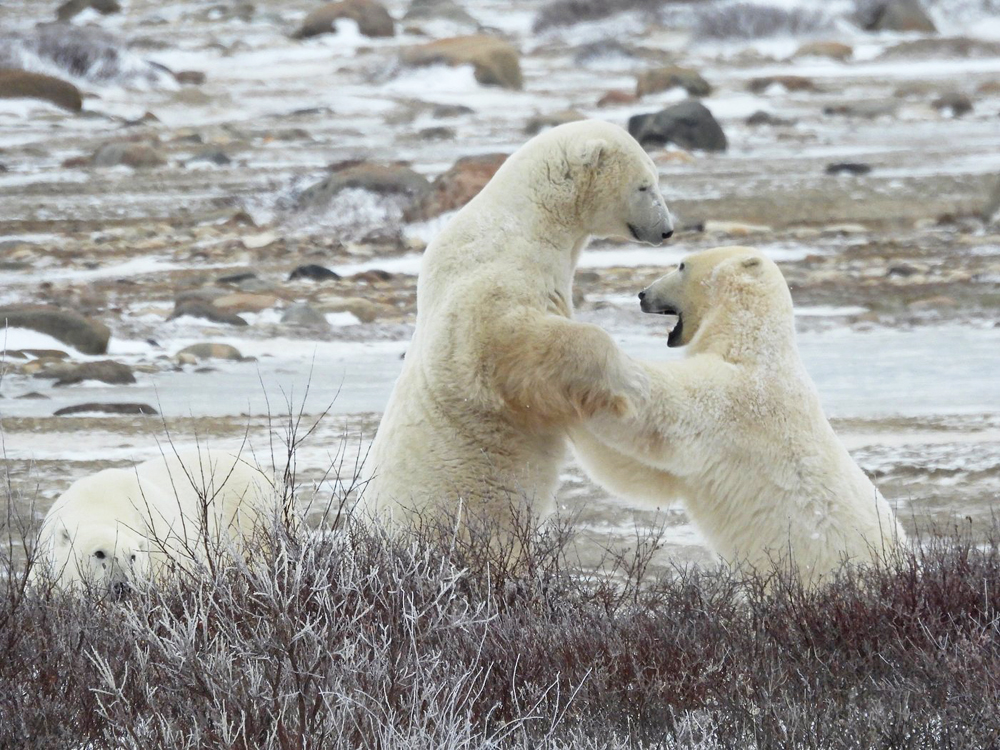
Polar bears sparring at Dymond Lake Ecolodge. FarAway57036974888 photo from Tripadvisor.
Seal River Heritage Lodge is 60 kilometres north of Churchill at the Seal River estuary. The Seal River brings cold fresh water into the bay, and the estuary is one of the largest beluga whale gathering sites in the world. In summer, thousands of belugas pass within view of the lodge. Polar bears walk the same coast at the same time, and this is the lodge from which the famous beluga hunting behaviour has been filmed for the BBC, National Geographic, and Sky Nature.
All three lodges sit on the same corridor. Each one shows a different chapter of the same story.
What guests should know before they come
The Polar Bear Highway is open from July through November. The experience is different in each month, and there is no single best time to visit. Guests who want green tundra, belugas and relaxed bears come in July and August. Guests who want fall colours, red and gold coastal grasses, and bears beginning to move come in September. Guests who want snow, sparring and the build-up to freeze-up come in October and November.
The safaris are guided on foot by some of the most experienced polar bear guides in the world. Safety protocols are decades deep. The lodges are permanent, full-service, and reached by short flights from Churchill.
The corridor is real. The bears are here. The only question is…
Which chapter do you want to see?
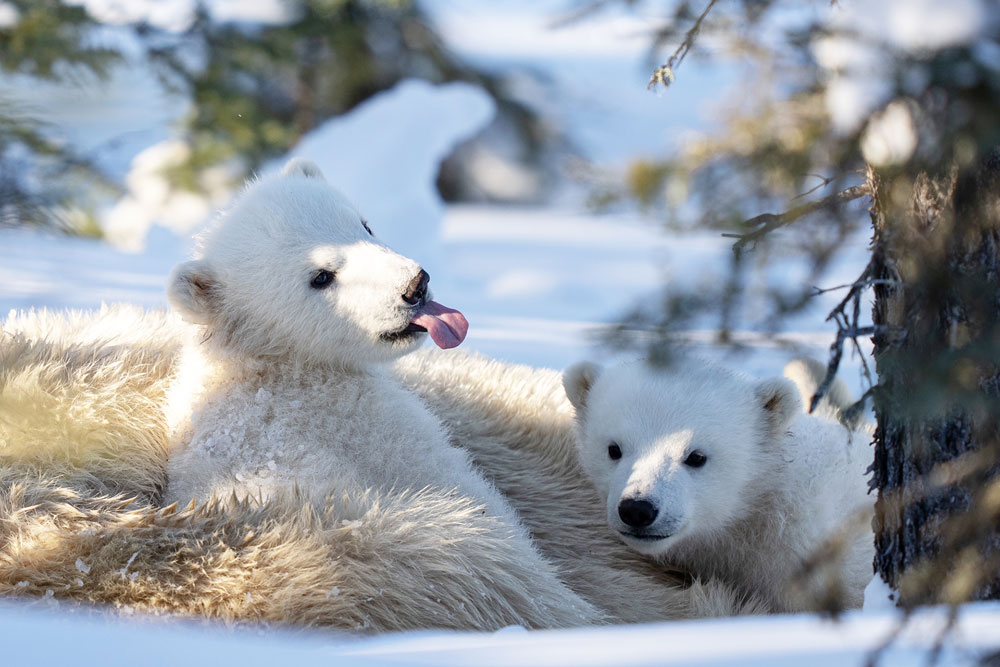
Cute polar bear cubs. Nanuk Polar Bear Lodge. Fabienne Jansen / ArcticWild.net photo.
Frequently Asked Questions
What is the Polar Bear Highway? The Polar Bear Highway is the coastal corridor along the western and southern shores of Hudson Bay that polar bears walk from July through November after the sea ice melts. It runs from northern Ontario, past Manitoba, and on into Nunavut.
Where do polar bears go in the summer? Polar bears of the Western and Southern Hudson Bay subpopulations come ashore once the sea ice melts. They walk the Hudson Bay coast, rest in cool dugouts, scavenge for food, and wait for the bay to freeze again in late fall.
Can you walk with polar bears anywhere else in the world? No commercial operation in the world offers polar bear walking safaris from permanent luxury ecolodges other than Churchill Wild. The combination of southern latitude, accessible coast, and bears spending months on land makes the western and southern Hudson Bay coast unique.
Do polar bears really hunt beluga whales? Yes. At the mouth of the Seal River, polar bears have been observed climbing onto large boulders and leaping onto belugas that swim too close during summer. The behaviour has been documented by Churchill Wild guides since 2017 and filmed by the BBC, National Geographic, and Sky Nature for major wildlife series. Scientific literature notes similar behaviour was recorded in Canada’s far north in the 1980s.
When is the best time to see polar bears on the Polar Bear Highway? Polar bears can be seen along the corridor from July through November. Summer offers green tundra and beluga whales. Early fall offers colour and the beginning of bear movement. Late fall offers snow and the build-up to freeze-up.
Where are Churchill Wild’s lodges located? Nanuk Polar Bear Lodge is 250 kilometres southeast of Churchill on the southern Hudson Bay coast. Dymond Lake Ecolodge is north of Churchill in tundra country. Seal River Heritage Lodge is 60 kilometres north of Churchill at the Seal River estuary. All three sit directly on the Polar Bear Highway.
How does climate change affect the Polar Bear Highway? Hudson Bay is freezing later and melting earlier than it did in past decades. Polar bears are spending more time on land each year, which extends the period during which they walk the corridor but increases the length of their summer fast. Whether longer time on land is also changing bear behaviour, including beluga hunting at Seal River, is a question researchers are now actively investigating.