
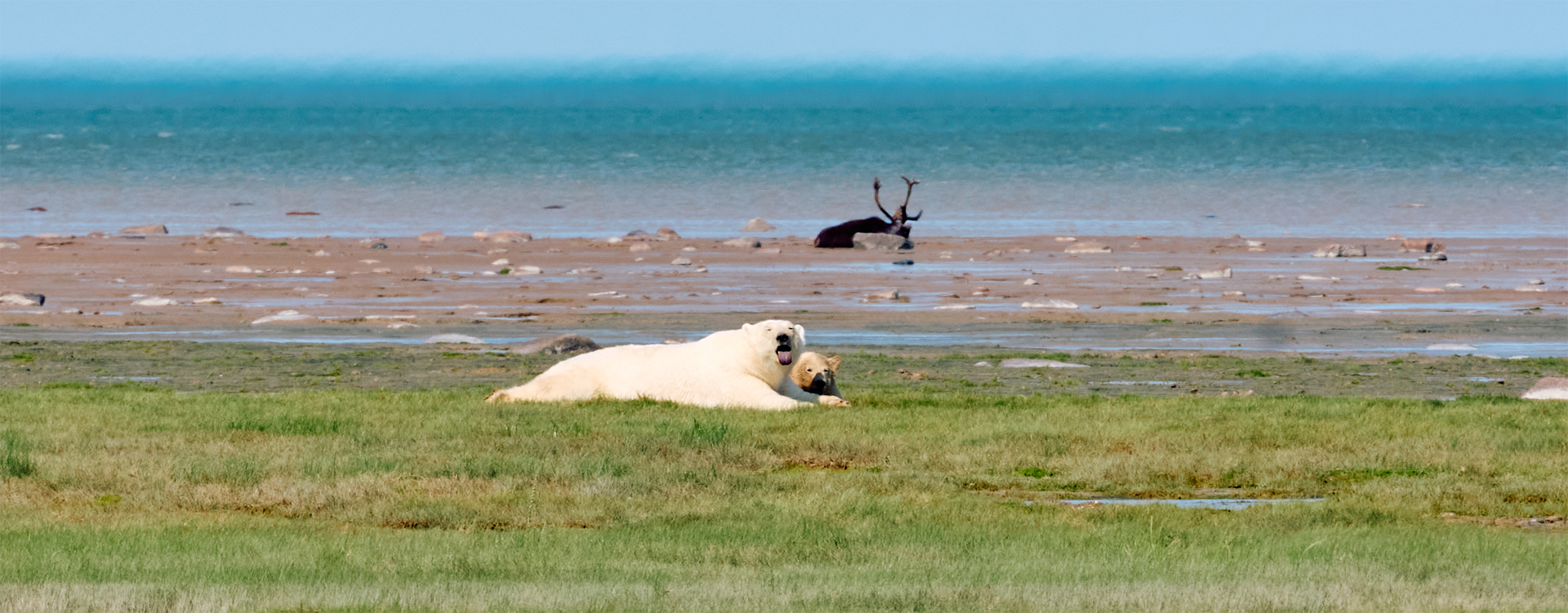
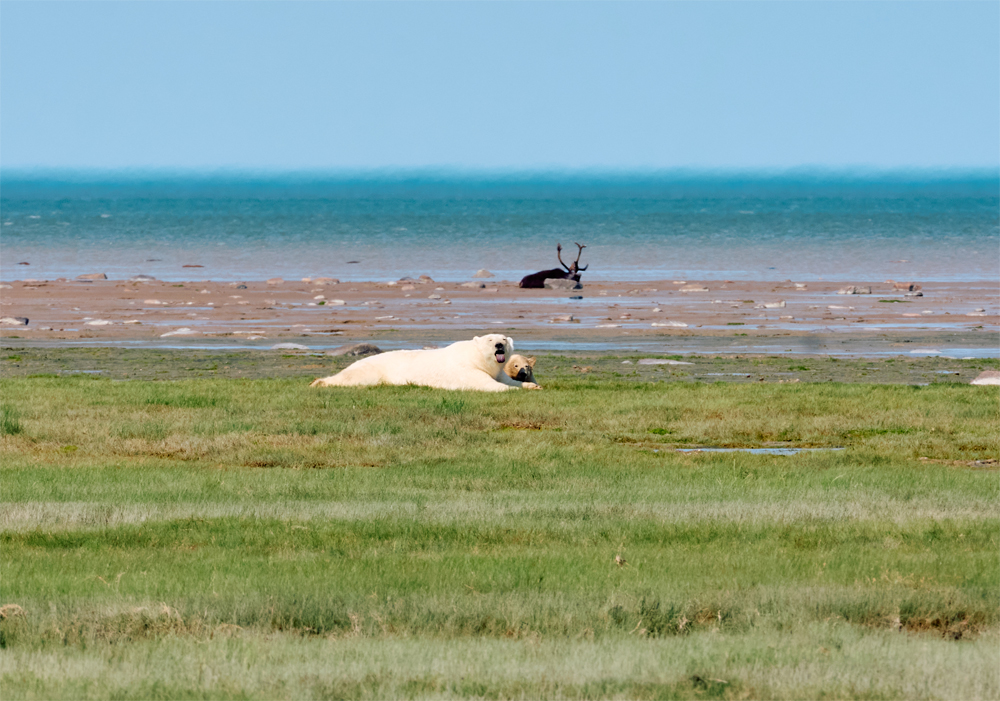
Rare shot of a polar bear mother and cub with a caribou in the background. Nanuk Polar Bear Lodge. Jesus Martinez photo.
Jesus Martinez came to Hudson Bay with a job to do, and it was not sightseeing.
He runs Dream Destinations Mexico, a travel company with 45 people on staff, about 30 of them in sales. Travel Manitoba covered his expenses so he could join an Arctic Discovery departure at Nanuk Polar Bear Lodge and settle one question for his market: will Mexican travellers want this?
He has been sizing up other people’s trips most of his life. This one got away from him.
He saw the bears first from the air, when the pilot dropped lower over the beach and moved the plane from side to side so everyone could see them.
“You have sunny days and polar bears pop out,” said Martinez. “It’s kind of like they’re shining.”
On the ground he watched them come up out of the water and settle on the sand.
“I was kind of like, oh, so this is their summer escape,” said Martinez.
He didn’t know it yet, but before the week was out he would take a photograph nobody at Nanuk can remember anyone taking before.
What happens on the first day?
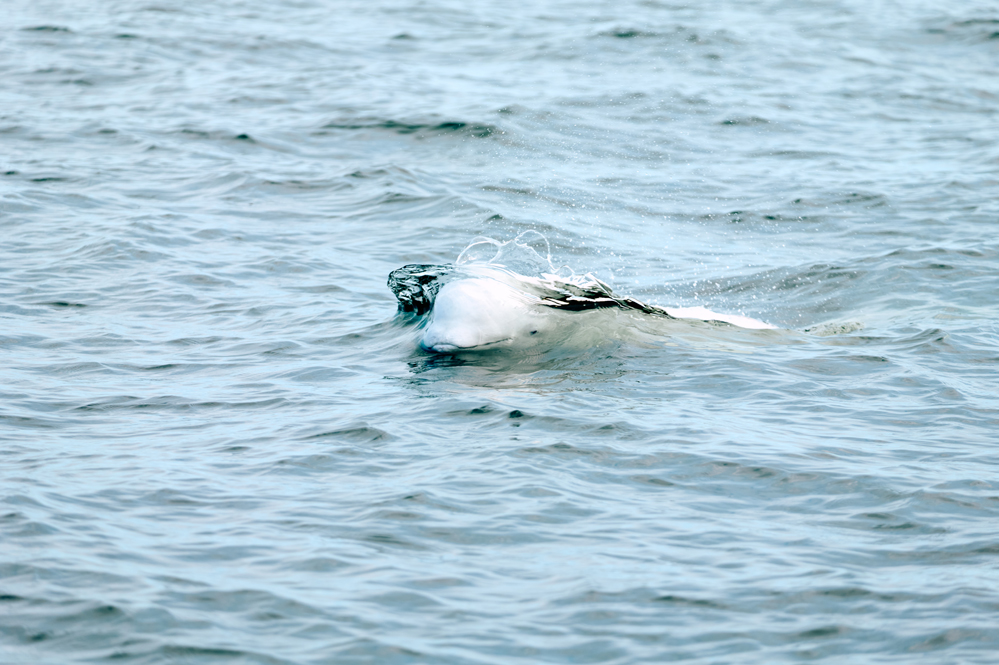
Beluga whales were the highlight of the first day on the Arctic Discovery. Jesus Martinez photo.
The Arctic Discovery starts in Winnipeg and moves to Churchill before the flight down the coast to Nanuk Polar Bear Lodge. Wind cancelled the kayaks on his first afternoon, so the group went out on Zodiacs instead, eight to a boat. They had barely left the dock before the belugas were alongside, a few metres off.
“It was already a lot to absorb, and the beginning of a great trip,” said Martinez. “It was exciting, and a very close encounter.”
He had packed a hydrophone nobody had asked him to bring. He put it over the side and let it run.
“I just put it down and recorded, and afterwards, when I was reviewing it, it’s kind of like, this is quite something, and great conversation that I hear from underwater,” said Martinez.
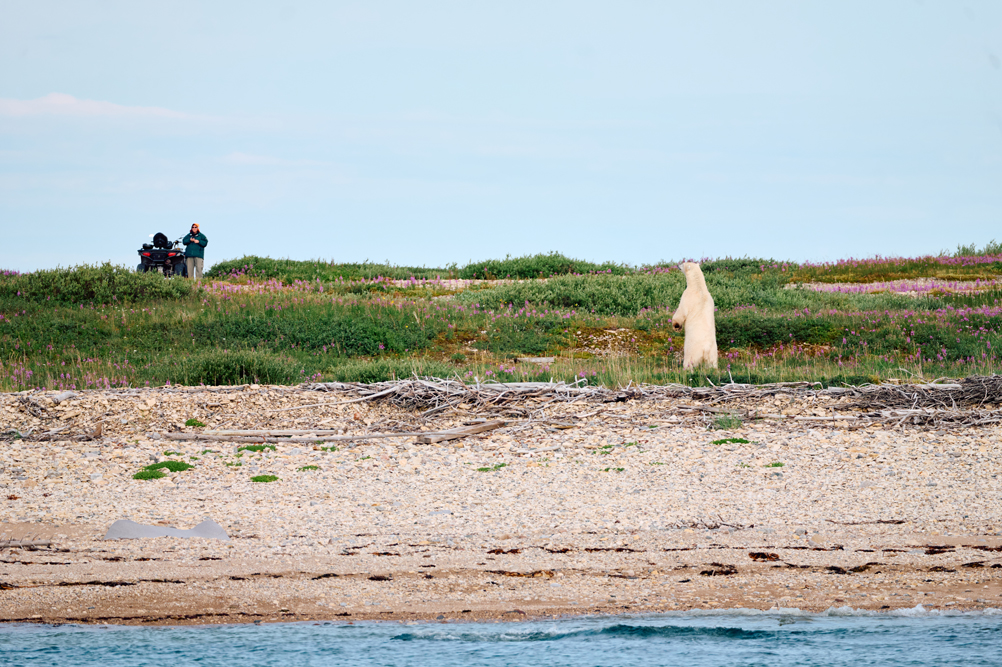
As seen from the Zodiac. Polar bear standing and watching a bear guard in Churchill. Jesus Martinez photo.
Then the guides asked whether the group wanted to see a polar bear. There was one on the other side of the water. Nobody needed convincing.
The group got on the water three ways that week, by Zodiac, by kayak and on a larger boat. The kayaks came out on the last day, in cold and rain, but nobody minded.
Is it safe to walk with polar bears?
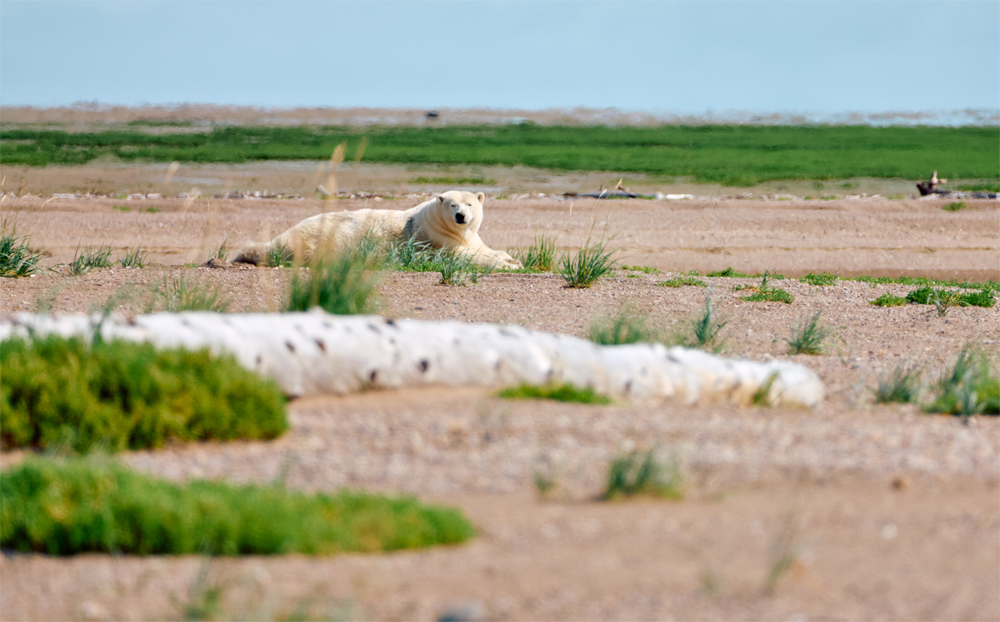
Polar bear relaxing on the beach at Nanuk Polar Bear Lodge. Jesus Martinez photo.
Guests at Nanuk walk out to polar bears on foot with guides who carry a range of deterrents, in single file, in a V formation that gives everyone a sightline. One rule sits at the centre of it.
You cannot startle a polar bear.
“The thing that stuck to our minds was we want them to smell us to know that we’re there,” said Martinez.
Every instinct he arrived with said to do the opposite.
“For me it was kind of shocking that you have to let the wildlife know you’re there,” said Martinez.
Guests here do not often put it that way. Martinez had already worked out why the rule holds.
“I think it makes sense because obviously we share a planet and we have to get to know how to handle each interaction we have everywhere,” said Martinez.
“And we have to let them know we’re there and we’re not there to hunt them or do any harm. And we need to respect both sides. So that was a great learning for me.”
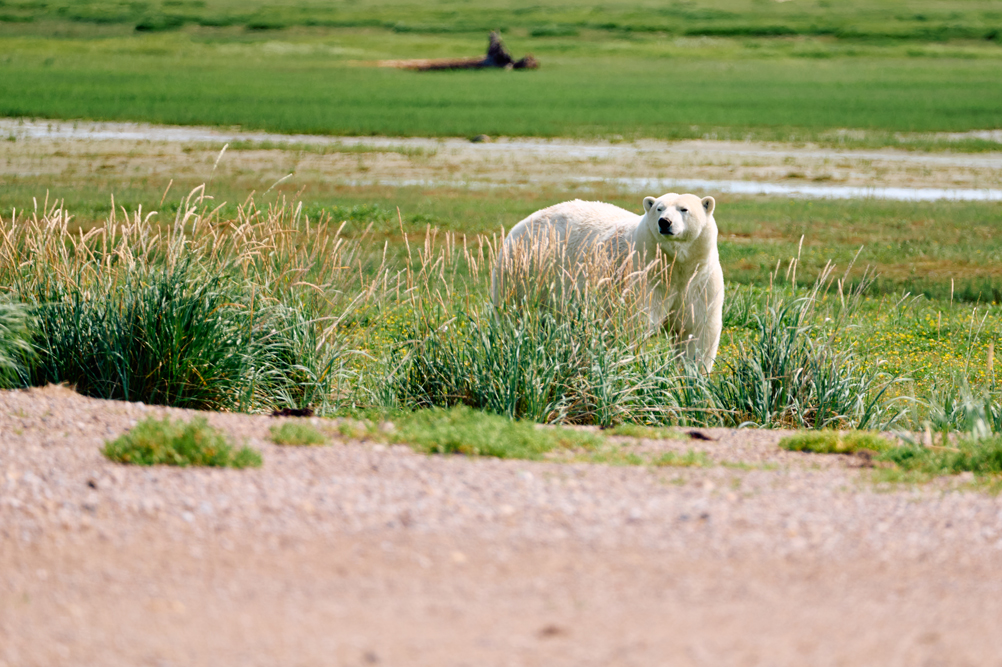
Polar bear watching guests at Nanuk Polar Bear Lodge. Jesus Martinez photo.
They spotted the first bear from the lounge over lunch, which is why lunch went fast. Rain gear, five minutes on the ATVs, then everybody walked. The bear woke up, looked them over, took a few steps and lay back down.
“It was kind of like, okay, I see you, and maybe I don’t care, and I’ll go back to sleep,” said Martinez.
The group came back in super excited and eager for more.
The closest encounter came later in the week, with a mother and a cub, and it was the cub that closed the distance.
“The cub was very curious, so he was walking towards us a few times and he was getting so close,” said Martinez. “And obviously you want to be as still as possible.”
It was also the hardest photograph he tried to take all week. A moving animal on a long lens is difficult to hold focus on, and what he wanted was the eyes and the fur sharp.
What wildlife can you see at Nanuk in summer?
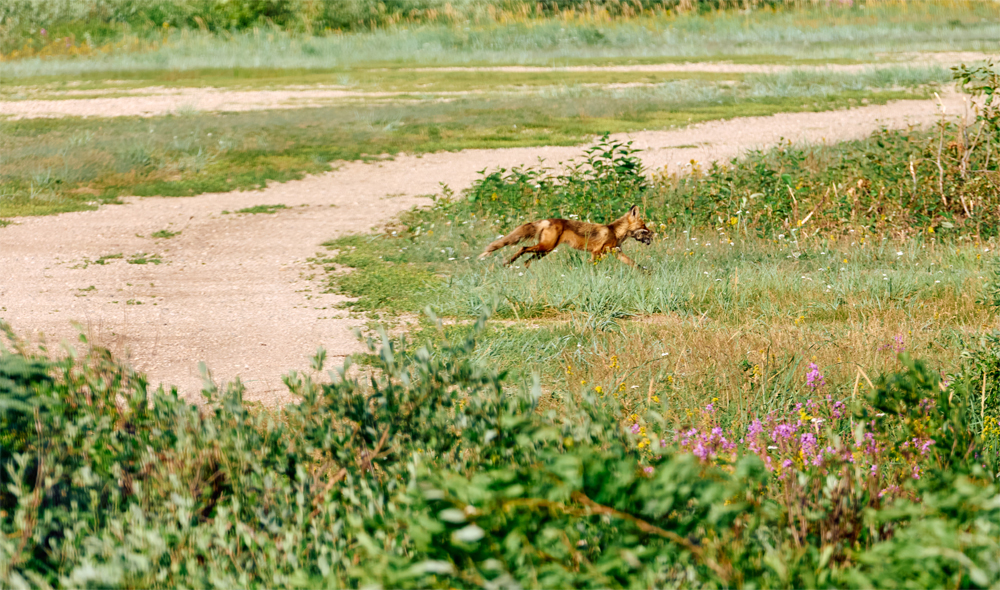
Punctual red fox on the move with prey at Nanuk Polar Bear Lodge. Jesus Martinez photo.
Nanuk Polar Bear Lodge sits where the boreal forest meets the tundra and the bay, which is why the species list runs long. Martinez saw polar bears, belugas, a black bear, a red fox with pups and caribou on one summer departure.
The black bear went past the lodge most evenings around six o’clock, headed for the berries.
“He was our friendly neighbour,” said Martinez. “Always eager to eat some berries around there.”
The fox kept the same schedule, and she always had something in her mouth: rodents, birds, whatever the day had turned up. Every so often the pups came out and horsed around on the runway.
“She was also very, very punctual,” said Martinez.
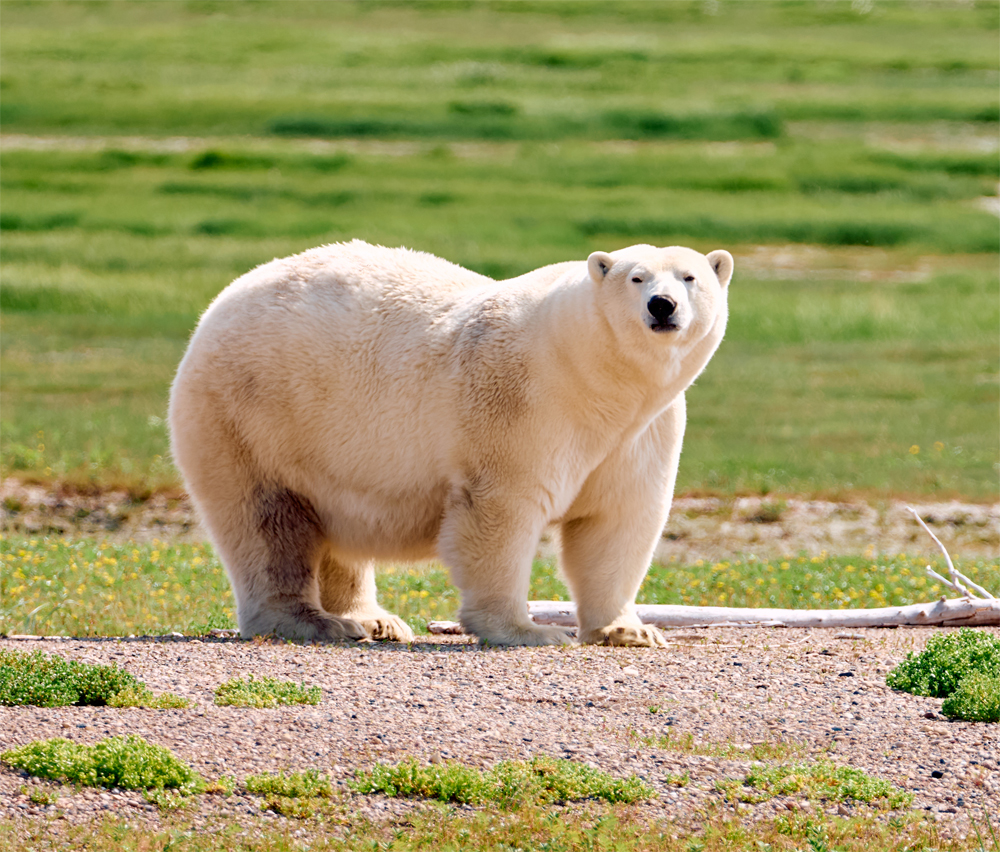
Contender for the fat bear contest. Nanuk Polar Bear Lodge. Jesus Martinez photo.
The bear that got the most attention came near the end. She was enormous, and the group started campaigning for her.
“The most interesting bear, one of the last bears that we saw, was this huge female,” said Martinez. “They were nominating her for fattest bear of the year. Because she was so huge. You could see that she had a good winter eating seals.”
The caribou were the surprise. He counted three or four, some at distance, and then the group got close to one.
“They had their antlers so big, and they were super strong and mighty,” said Martinez.
He asked the guides the obvious question about sharing ground with polar bears, and was told the caribou would outrun them. Then he got a frame with a polar bear and a cub in the foreground and a caribou lying down in the distance, all in one shot, and sent it to Churchill Wild.
“They told me it was unusual,” said Martinez.
Nobody at Churchill Wild could recall a polar bear and a caribou together in the same photo.
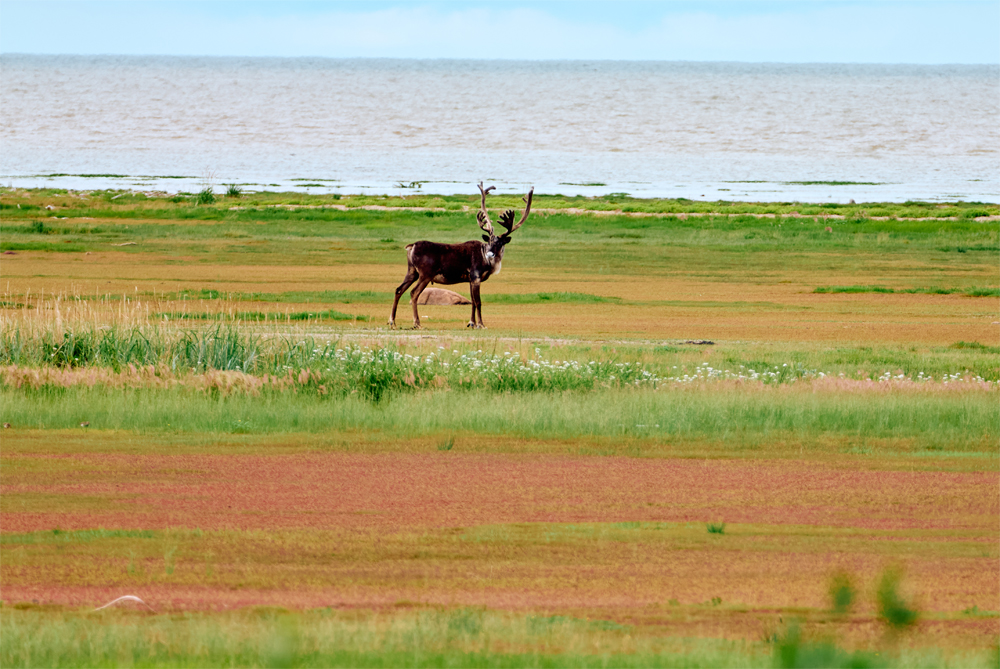
Caribou on the flats at Nanuk Polar Bear Lodge. Jesus Martinez photo.
Joy, 80, and the night the sky opened
The group came mostly from Canada and the United States. By dinner on the first night they were all friends.
“I believe in the concept of tribes,” said Martinez. “And I think that in life you get to find your tribe when you travel. You find people with the same interests and the same ideas, but maybe they come from a very remote country.”
The one he still thinks about is Joy, who is 80 and lives in San Francisco. She worked out early that Martinez was the man to know about the northern lights.
“And she told me, you open the door and you shout, Joy, the lights are out. And I did that. And she came out in her pyjamas and she didn’t mind,” said Martinez.
It had been cloudy earlier that night, but the wind came up and opened the sky over the viewing tower.
“I told them, this is one of the biggest northern lights that I’ve seen in a place because there’s no light pollution,” said Martinez.
He walked the others through their camera settings and stayed up there until two in the morning.
The one that stayed with him
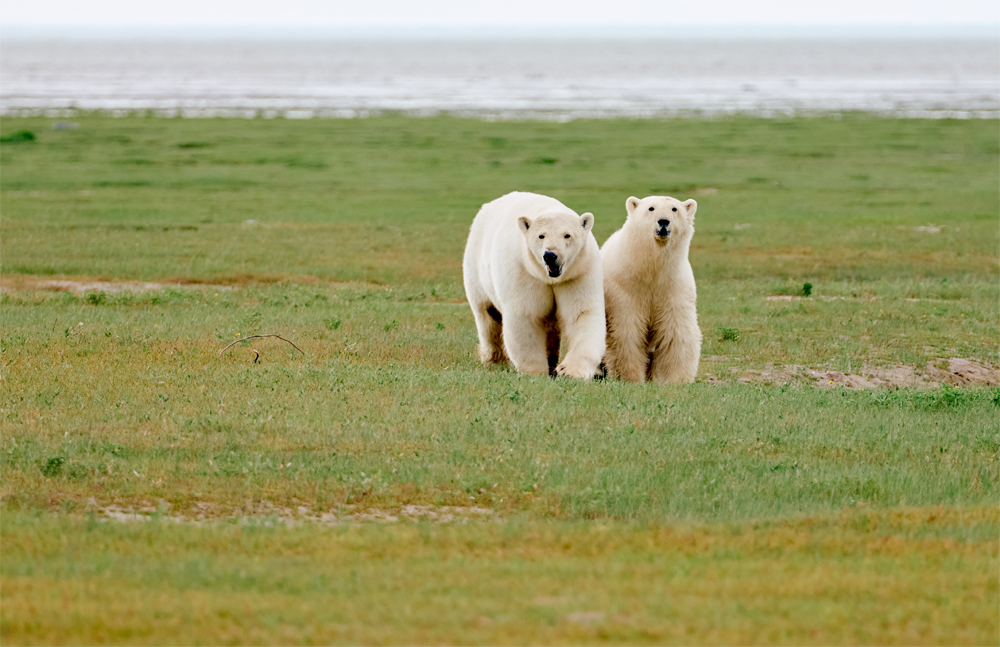
How much longer will they be together? Jesus Martinez photo.
Somewhere in the middle of the week the group came upon a female with a cub old enough that it was nearly time for the two of them to part. Martinez asked the guides how it ends.
“I asked lots of questions,” said Martinez. “Like, is there some moment when she’s going to say goodbye? I was even a little bit emotional. And once they part, do they keep in touch? But the answer was no, you’re human. You’re watching with human eyes.”
He wants that correction in the film he’s making.
“I think that’s the main thing that everybody should know,” said Martinez. “And when I film, I want to portray that it’s a close encounter with a wild animal. But if you keep it respectful with a safe distance, it doesn’t affect the bear at all.”
That was the week the bears gave him. The part he didn’t expect was everything in between, and he had come to assess all of it.
What is the food like?
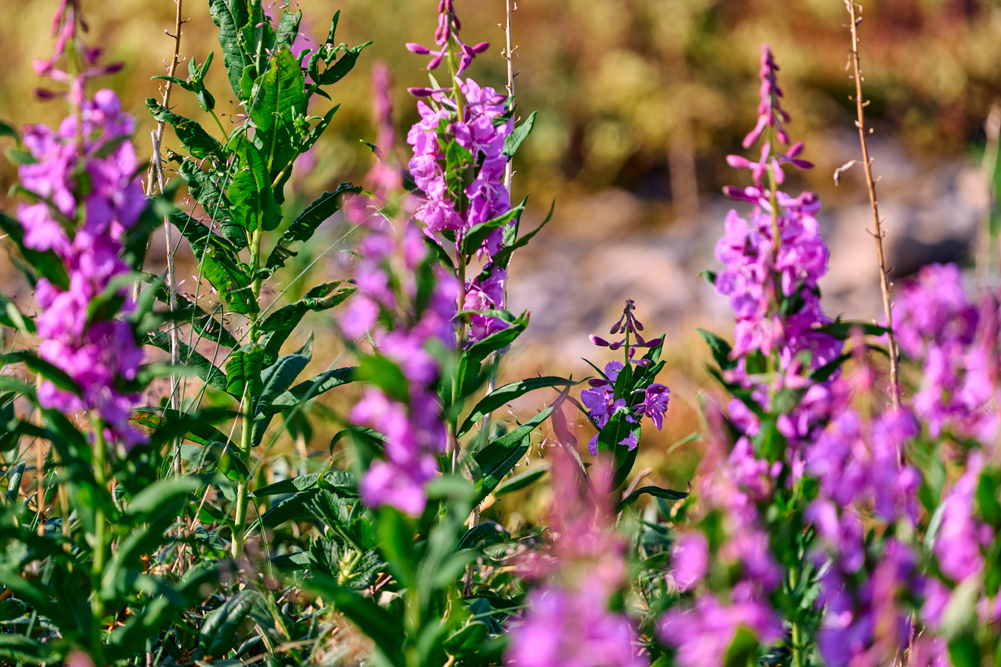
Beauty is easy to find at Nanuk Polar Bear Lodge. Jesus Martinez photo.
Everything a lodge like Nanuk serves has to be flown in, although wild berries around the lodge are on the menu in season. Martinez eats a pescatarian diet when he travels and forgot to mention it before he arrived. It made no difference.
“They fed me more than well, either vegetarian options or fish,” said Martinez. “And I was spoiled for the whole trip.”
What he talks about is the kitchen rather than the menu.
“The chef was always happy and singing,” said Martinez. “I loved his playlist. He was super excited, and that’s the energy that you want on a trip. Someone who is excited for you to try his food.”
The bill came due at home in Mexico.
“I got back home and looked in my fridge and, like, now I’m depressed,” said Martinez.
What are the rooms like?
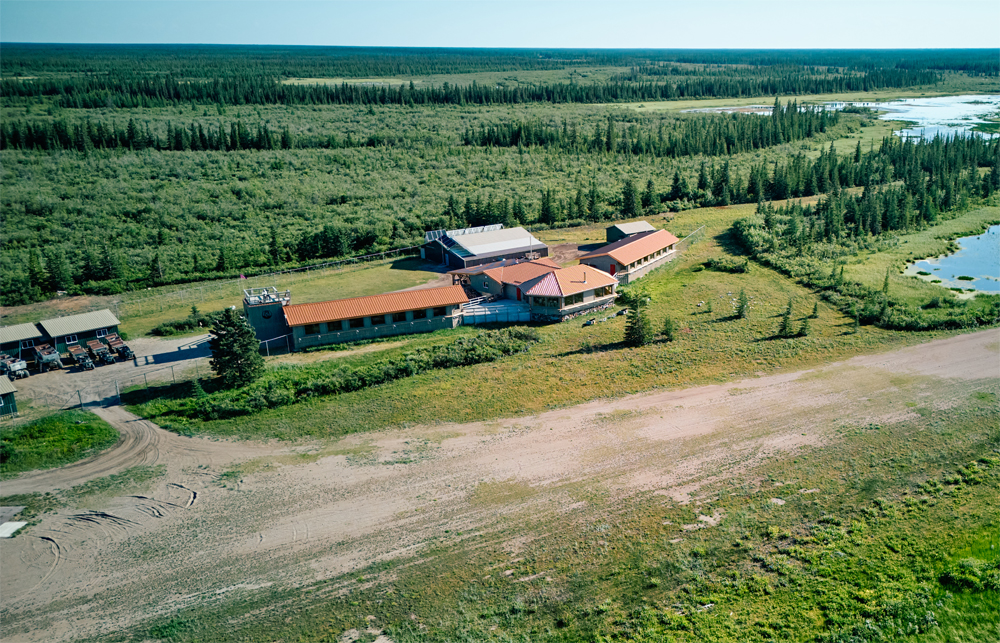
Nanuk Polar Bear Lodge from the air. Jesus Martinez photo.
Martinez stayed at two Churchill Wild properties, the Blueberry Inn in Churchill and Nanuk Polar Bear Lodge down the coast. He knows how hard it is to build anything that far from a road, and he arrived expecting to rough it. He also turned up with a hard-shell suitcase he had been told not to pack, which went back to Winnipeg. Churchill Wild lent him a soft bag.
He was told before he left that he would be sharing a room, and didn’t mind.
“It was more than cozy,” said Martinez. “The rooms were comfortable. We slept quietly. We had warm water. And light, and electricity. And we were able to touch back with our homes through the internet that you have in the middle of nowhere. So I think it covers more than what you were expecting.”
He liked the decor, and the slippers by the door, worn instead of shoes to keep the floors clean.
“You might feel you’re confined to a small space, but you didn’t feel confined at all,” said Martinez. “You felt comfortable because you were in the vastness of the outdoors. It was a great spot, like a home for a few days.”
Who looks after guests at the lodge?
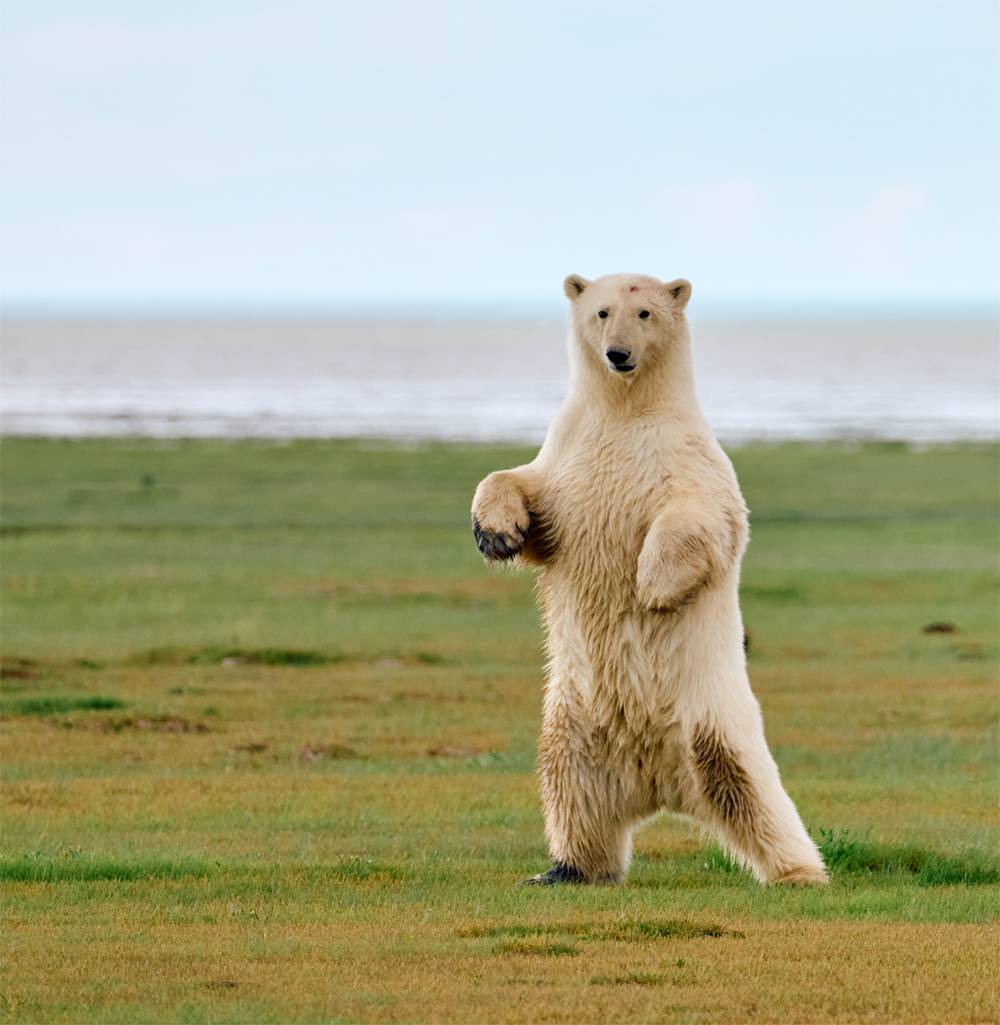
Tough guy polar bear cub. Nanuk Polar Bear Lodge. Jesus Martinez photo.
The guides and staff at Nanuk eat at the table with guests. Martinez made the most of it, sitting down with the lodge managers, the guides, staff and Sarah the baker, several of whom turned out to be from New Zealand.
“For whatever reason in life, we’re sitting down face to face, and I want to know why,” said Martinez. “What made you, or what decisions did you make in life, so that you’re here today?”
Evenings ran on presentations, including a polar bear talk from Emri Canvin, the senior guide on that departure.
“When you watch him, it’s kind of like, yeah, I would trust my life in his hands,” said Martinez. “And I want him on my team because he knows the behaviours. He knows how to interact. One of the things that I like is that they give you the confidence. When you’re in a vulnerable environment, you need people to give you confidence.”
Out on the walks and on the Rhinos, the group rotated positions so nobody spent the day behind someone else’s shoulder.
“We were actually extraordinarily pleased with how we were treated,” said Martinez.
What does luxury mean out there?
Martinez sells luxury travel for a living, which is what makes his definition of it worth hearing.
“For me, the luxury is not necessarily having the best linens and having a butler and having upscale products in your bathroom,” said Martinez. “For me, the luxury is a type of experience where you forget about everything else. You’re connected to the moment, and the remoteness and the vastness of the planet, and seeing it firsthand with a few people that also have the same interests. Doing the whole combination of walking outside and getting close to a polar bear. That’s luxury for me. More than being in a fancy hotel with fancy food.”
Will it sell in Mexico?
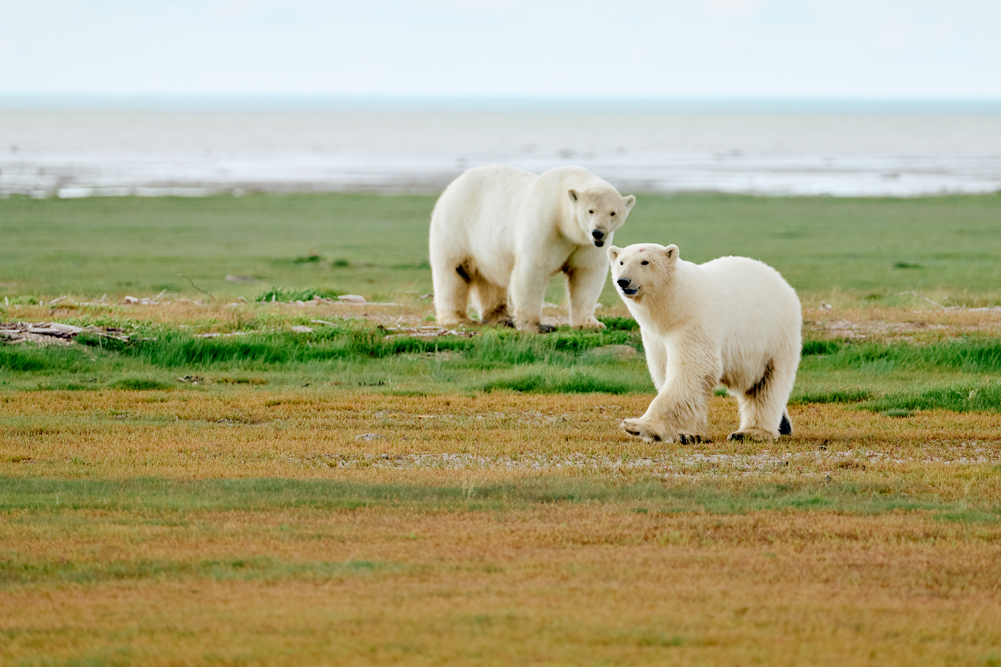
Polar bear cub on the move at Nanuk Polar Bear Lodge. Jesus Martinez photo.
Canada is the fastest-growing travel product at Dream Destinations Mexico, and for years it meant Montreal, Toronto, Ottawa and Vancouver. Then Martinez started asking what else was out there. Travel Manitoba wanted into the Mexican market. There is no direct flight, and the first thing anybody wanted to talk about was polar bears, which sounded to him far away, cold and wild.
“For me, polar bears were something so remote and so maybe inaccessible,” said Martinez.
Then somebody explained that there are ecolodges on the Manitoba coast where guests walk out and meet polar bears on foot in summer, fall and winter, from a safe distance, and come back in for dinner.
His clients now ask him the same things. Is it cold? Is it far? Is it expensive? He likes the questions, because a client asking is a client who is halfway there. On the cold, he tells them to come in summer.
“For me, tourism in changing environments is just a question of having the right equipment,” said Martinez.
On price, he itemises: the remoteness, the charter flights, getting water and food into the lodge, staff working around the clock, and the best polar bear guides in the world.
“People think that some things are expensive when they don’t see the value in them,” said Martinez. “You have to give value to the experience so they can see why there’s a bigger cost than maybe what they thought.”
Churchill Wild runs small groups on limited departures, so the trip has to be booked well ahead. He uses that as the argument rather than the obstacle, because the lead time is what gives a client room to build the budget.
“But it’s possible,” said Martinez. “If you put your mind to it, it’s for everybody to experience.”
And his clients are changing.
“People are getting comfortable with the uncomfortable,” said Martinez.
The other side of the mountain
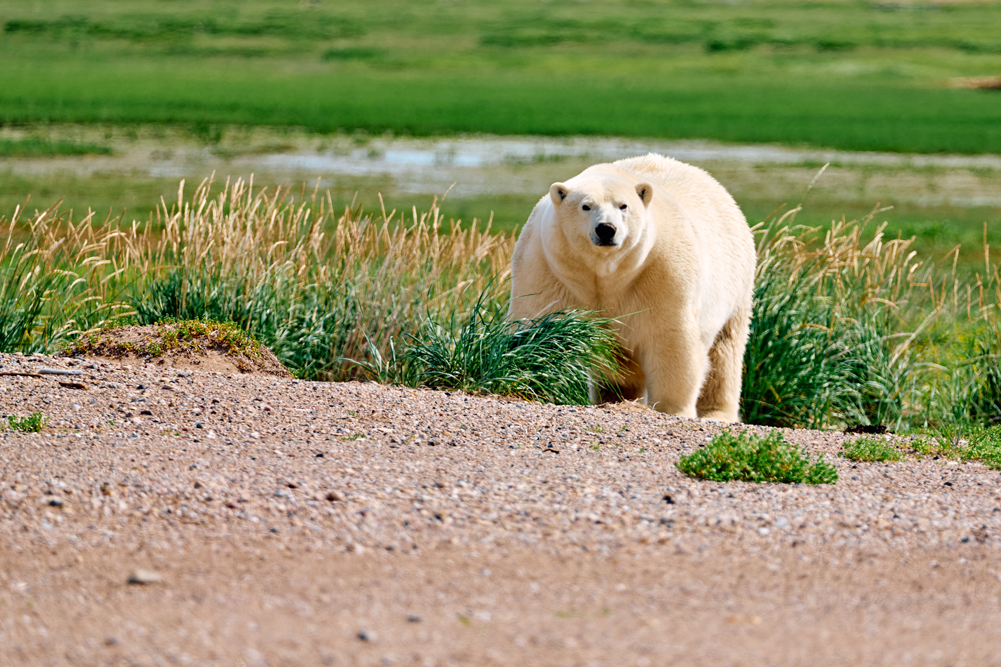
Fat polar bear in the beach grass. Nanuk Polar Bear Lodge. Jesus Martinez photo.
His family started the business in 1988. He studied engineering for a while, but it did not take. Travel had got to him long before that.
“My first trip that I remember, I went to Alaska with my grandmother,” said Martinez. “She was excited for me and my cousins to see the world.”
Martinez is turning 50, he’s not bothered by that, and he’s creating a film about his travels.
“You don’t have to work for the big media or be a reporter,” said Martinez. “Regular people do amazing things.”
He has a phrase for what he wants his film to do. He used it three times in an hour without being asked.
“I want to plant the seed for whatever decision you make, to go and see what’s on the other side of the mountain, not just the mountain,” said Martinez.
Martinez came to find out whether Nanuk Polar Bear Lodge was a dream destination. The polar bears answered that question for him. Whether polar bear safaris would sell in the Mexican market was his other question.